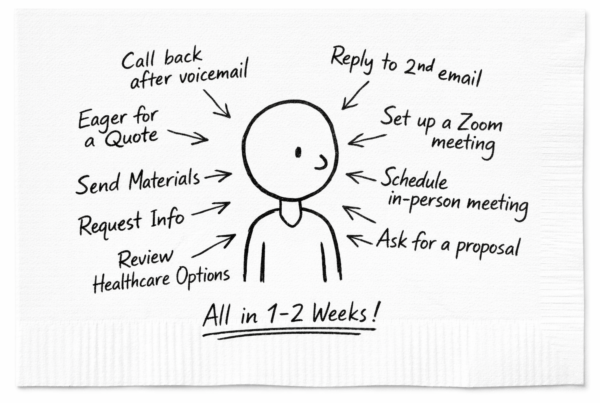
Change Triggers are early signals that a company is likely to make a benefits decision soon, even if leadership hasn’t admitted it yet. In our world, “need” rarely arrives as a clean request. It shows up as pressure: leadership changes, renewal proximity, service breakdowns, growth or M&A, employee noise, or cost volatility. Triggers matter, because they move a prospect from “fits on paper” into “we actually move.”
In this post, I cover one of the most important triggers that is very difficult to ignore, even in the deepest “Status Quo” situation – Employee Noise.
Employee noise is measurable long before anyone admits it. The mistake brokers make is evaluating the health plan from the employer’s perspective (“premium, renewal, carrier, network”), when the noise is created on the employee’s side of the counter.
Read a Healthcare Plan Like An Employee
What do they actually pay when they use care, and what do they get for their money?
Deductibles, coinsurance, out-of-pocket max, Rx tiers, out-of-network exposure, and the practical friction points (prior auth, narrow networks, balance billing risk).
Once you see the plan through that lens, you can estimate where frustration is inevitable.
Then quantify it using data you can gather without HR. Find headcount, job mix, and compensation ranges. If the company is public, much of this is easier; if it’s private, you can still triangulate via job postings, LinkedIn headcount distribution, and salary benchmarks. Compare the plan’s employee cost exposure (deductible + likely out-of-pocket behavior) against typical wages for the majority job categories.
If the math implies that a meaningful portion of employees are regularly exposed to a painful percentage of their take-home pay, there will be noise, whether HR is ignoring it, leadership is insulated from it, or a gatekeeper is trying to block it. When money gets involved, people don’t stay quietly grateful. They get quiet, then they get annoyed, and eventually they get loud in ways the company can’t ignore.
Now Available on Amazon
Survivors inventors
A powerful playbook that shows you how to read every prospect’s mindset, smash through resistance to change, and unlock a clear vision of your brokerage’s future.

Questions To Ask A Decision-Maker
If you do get a conversation with HR, you still don’t ask the obvious question (“Do you have employee noise?”) because you’ll get the obvious answer (“We’re fine.”) Instead, you ask for stories that reveal the real operating reality. For example:
✔️ What was the last benefits issue that required escalation?
✔️ What did it look like, and how was it resolved?
✔️ Do employees typically solve issues through the carrier/TPA, or do they come to HR first?
✔️ What’s the most common point of confusion employees have about the plan?
✔️ When was the last time an employee thanked you for helping fix something that was initially denied or mishandled?
These questions force specifics. Specifics reveal friction. And friction, when it repeats, is employee noise – whether the organization admits it or not.
In prospecting, patience is the tax you pay for real influence.
Margo White X
Prospecting Calculator
Run Sales Simulation
In seconds, you’ll see your future numbers, the deals you could unlock, and how sticking to the right targets reshapes your entire business.