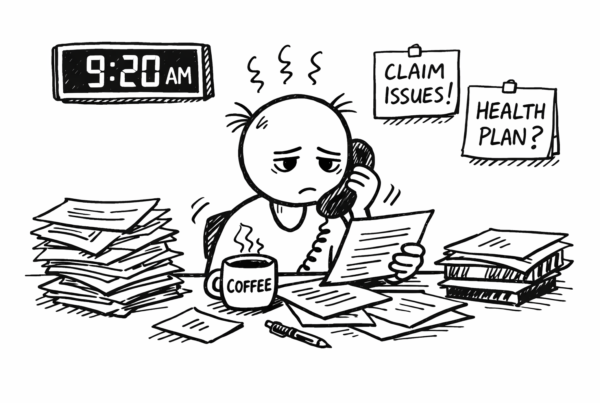
“It’s a lot of work to not do the status quo.” (Eric Dreyfus)
And he’s right. The status quo is not “winning” because it’s smart. It’s winning because it’s convenient.
Eric describes employer healthcare decision-making like a teeter-totter: cost on one side, convenience on the other. Most companies unknowingly pick one and sacrifice the other. If they prioritize convenience, costs keep rising. If they prioritize cost reduction without care, the employee experience becomes a disaster. The real goal is to keep the teeter-totter level: preserve usability for employees while building a cost structure that isn’t designed to inflate every year.
“On one end… is cost, and the other end… is convenience… [the goal is] how to keep the teeter totter level.” (Eric Dreyfus)
That framing is simple on purpose. Employers don’t need another benefits lecture. They need a mental model that explains why what they’re doing keeps producing the same outcomes. And they need to understand that the “do nothing” option is not neutral. It is an active choice to accept compounding cost and compounding employee friction.
Why the status quo survives: the renewal ritual and the slow-play
The most frustrating part of this market is not that employers are evil or incompetent. It’s that they’ve been trained. Incumbents train buyers to wait, to delay, to treat benefits like an “October problem,” and to believe a major change can be done like flipping a light switch. Then, when the employer finally looks up two months before renewal, they’re effectively trapped by time. Data arrives late. Procurement drags. The incumbent slow-plays information. Everyone panics. And the company says, “Let’s just stay the course and revisit next year.”
Now Available on Amazon
Survivors inventors
A powerful playbook that shows you how to read every prospect’s mindset, smash through resistance to change, and unlock a clear vision of your brokerage’s future.
Eric called it exactly as brokers experience it:
“They slow play… give you 90% of the data you need and then you gotta wait… By then it’s too late.”
This is the engine of the status quo. Not lack of options. Not lack of intelligence. The calendar. The timeline is the incumbent’s weapon. And the only way to beat it is to start early, before renewal season, with enough runway to educate, implement, and communicate without chaos.
The buzzword… in 2026… is fiduciary risk
Why 2026 changes the stakes: fiduciary risk and the end of “we didn’t know”
The forward-looking point Eric made, and the one I strongly agree with, is that 2026 may be a forcing function. Not because employers suddenly become more curious, but because risk becomes harder to ignore. Eric’s view is that “fiduciary risk” will be one of the defining pressures in 2026, driven by growing scrutiny and litigation.
“The buzzword… in 2026… is fiduciary risk.” (Eric Dreyfus)
He also made a comparison that feels uncomfortably accurate: if nobody is policing behavior, people get away with it , until they don’t. “If nobody’s policing it, you can get away with it,” he said. (Eric Dreyfus) And once enforcement starts, the defense of “we weren’t aware” becomes much harder to sell.
“It’s 2026, it’s not 2006… they can’t claim ignorance anymore.” (Eric Dreyfus)
That is the real takeaway for employers: you do not want to discover your plan’s weak points when the pressure is already on. You want to discover them early, on your own timeline, while you still have choices.
In prospecting, patience is the tax you pay for real influence.
Margo White X
The Golden Rule of Prospecting
Here’s the part that makes brokers uncomfortable: real prospecting takes time. Weeks. Months. Sometimes years. There’s no dopamine hit. No instant conversions. No three-click, Shopify-style deals.
But patience is the tax you pay for real influence.
Every serious player eventually learns this:
Marketing is optional. Prospecting is Oxygen.
In a world obsessed with impressions and “brand voice,” it’s easy to forget what actually moves money in B2B. And it’s not visibility. It’s not content calendars. It’s not clever copy.
It’s conversations.
It’s context.
It’s timing.
It’s persistence.
Marketing might open the door. But prospecting is the one that walks in, shakes hands, and stays until the deal is done.
Prospecting Calculator
Run Sales Simulation
In seconds, you’ll see your future numbers, the deals you could unlock, and how sticking to the right targets reshapes your entire business.